
Editorial
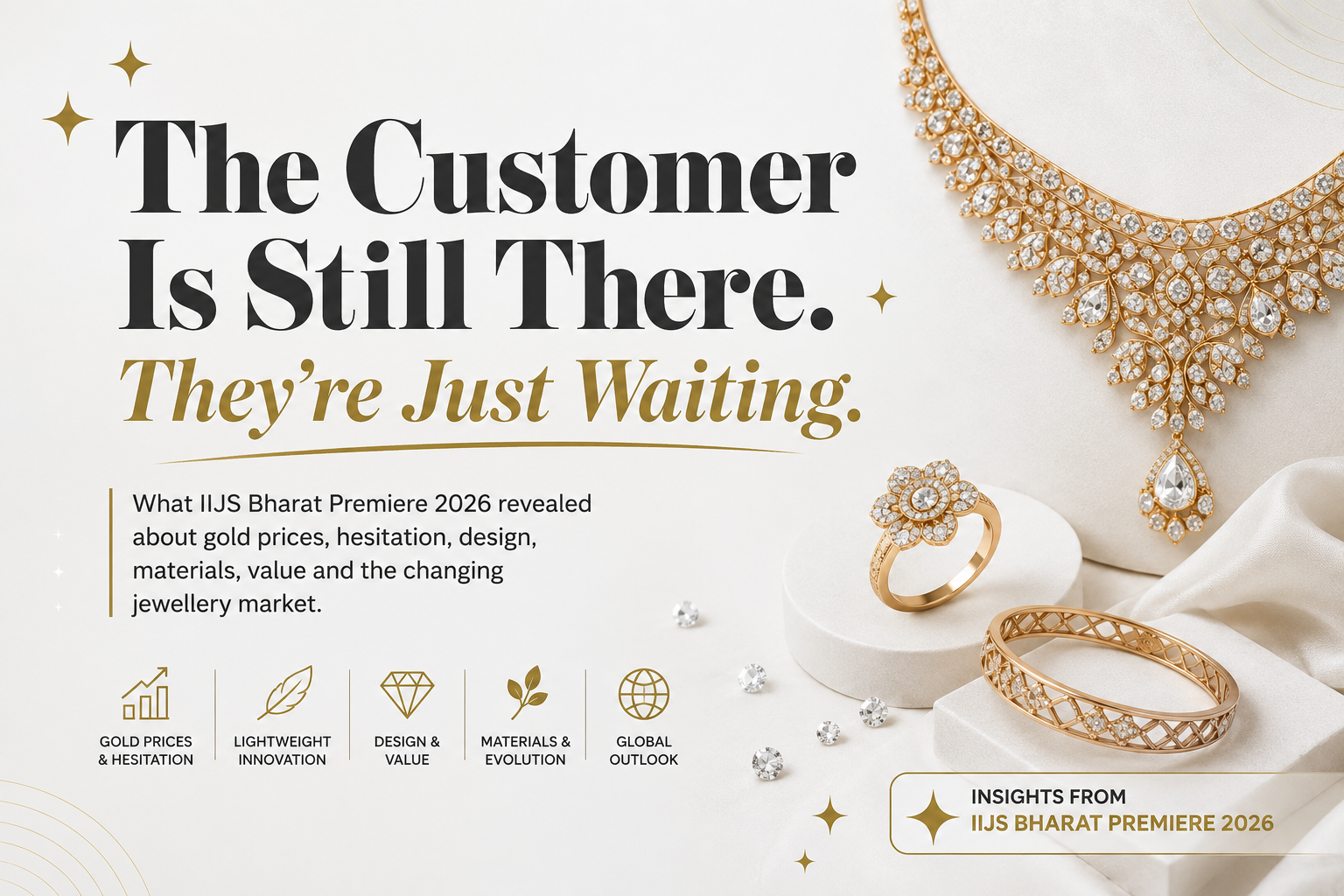
The Customer Is Still There. They’re Just Waiting.
What IIJS Bharat Premiere 2026 revealed about gold prices, hesitation, design, materials, value and the changing jewellery market.
There is a particular kind of fatigue that sets in after enough hours at a jewellery exhibition. After the first few halls, gold begins to blur into gold, diamonds into diamonds, and another elaborate necklace can struggle to hold your attention for more than a few seconds. What stays with you instead are the conversations: a retailer deciding how much inventory to commit, a manufacturer thinking about how many grams a necklace really needs, a buyer looking for something familiar without being predictable, a designer trying to make an old language work for a new wearer. It is somewhere in these conversations, rather than in the sheer volume of jewellery on display, that a trade show begins to reveal what is happening underneath the business.
IIJS Bharat Premiere 2026 was large enough to make that difficult to miss. The 42nd edition brought the industry together across the Jio World Convention Centre and Bombay Exhibition Centre, with more than 2,100 exhibitors and over 3,600 stalls spread across 135,000 square metres. GJEPC’s post-show figures recorded 56,978 unique visitors representing 24,525 companies, total footfall of 202,880 and more than 5,000 international buyers from over 80 countries. But there is an important distinction to make about those numbers. IIJS is not a consumer jewellery fair. It is a B2B marketplace where manufacturers, retailers, exporters, designers, technology providers and buyers come together to decide what will eventually reach the customer. The consumer is not necessarily walking through the aisles; their preferences arrive indirectly, carried into the halls through the people making, buying and selling jewellery.
Gold-price volatility offered one of the clearest glimpses into that customer psychology. When JD asked Shrayansh of Dilips Jewel House what changes in consumer behaviour when gold prices become volatile, the 26-year-old second-generation jeweller’s answer was surprisingly simple: “They stop buying.” Customers, he explained, tend to pause their purchases, watch the market and wait to see whether prices stabilise. Once the uncertainty settles, they return. For the jeweller, the slowdown does not necessarily mean demand has disappeared; often, the purchase has simply been pushed forward until the customer feels more comfortable with the price.
It is a small observation, but perhaps one of the more useful ways to understand the current jewellery market. A customer who waits is not necessarily a customer who has walked away. They may still want the necklace, the ring or the pair of earrings. They may simply be unwilling to decide today when tomorrow’s price feels uncertain. And that distinction matters to an industry accustomed to reading sales as a fairly straightforward measure of demand. If the purchase is deferred rather than abandoned, the industry’s challenge changes. It is no longer simply about convincing the customer to spend; it is about giving them enough reason to spend when they decide they are ready.
That is where the conversations around weight at IIJS become more interesting. Lightweight jewellery was one of the clearest recurring directions across the show. With gold prices making every gram more consequential, manufacturers and retailers have a commercial reason to reconsider how much metal a piece really needs. The result was a visible movement towards lighter constructions and more accessible formats. But the more interesting question is not why jewellery is becoming lighter. It is why the industry is working so hard to make sure it does not look lighter.
The challenge is no longer simply to remove metal. It is to preserve proportion, presence, strength and finish while doing so. A necklace still needs proportion. A bangle still needs strength. A bridal piece still needs to feel substantial. The customer may be paying for less metal, but they have not necessarily lowered their expectations of what the finished jewel should look like. That is why lightweight jewellery is becoming less of a cost-saving exercise and more of a design problem.
At KIK Jewells, the response to lightweight handmade filigree was strong enough for the collection to sell out twice during the exhibition, according to Amit Soni’s account published by GJEPC’s Solitaire. It is a small but revealing detail. Lightweight jewellery is usually discussed as a response to expensive gold; the response to a design-led collection suggests something more interesting. When the design is compelling enough, lower weight can become part of the proposition rather than a compromise.
The same tension appeared when looking beyond the lower ticket. If high gold prices were simply pushing consumers towards cheaper jewellery, the market would be relatively easy to understand. But the picture emerging from IIJS was less linear. Pieces at more accessible price points were finding their audience, while differentiated and higher-value jewellery continued to attract attention. At Anan Jewels India, interest extended across fancy-colour diamonds, including yellow, pink, blue and green stones, while other exhibitors described demand across both more accessible and aspirational diamond categories. Ankita Jain of Anan Jewels captured the mood succinctly: “India is out to spend.”
Aaditya Shah of S. Vinodkumar similarly observed demand at both ends of the diamond market, from smaller diamonds that can add visual impact to gold jewellery without dramatically increasing its ticket to stones above two carats that continue to carry aspirational appeal. Put those observations together and the familiar story of a consumer simply “trading down” begins to look incomplete. The customer is not necessarily asking for the cheapest thing they can buy. They are becoming more particular about what deserves the money they are willing to spend. Sometimes that means fewer grams. Sometimes it means a more distinctive design. Sometimes it means colour or versatility. And sometimes, at the other end of the market, it still means rarity.
The question is increasingly not simply, What does this jewellery cost? It is, What am I getting for what I am paying?
Perhaps that is why the material conversation at IIJS was broader than gold alone. Silver had its own defined place within the show, alongside diamonds, gemstones, platinum, laboratory-grown diamonds and other jewellery categories. But the more interesting development was the willingness to move beyond the traditional material vocabulary altogether. GJEPC’s Solitaire profiled designer Mangesh Chauhan’s use of unconventional combinations including gold with resin and wood, while the Brilliant Bharat: Music of India showcase explicitly encouraged the mixing of materials not commonly associated with jewellery, including wood.
The significance is not that wood suddenly became a competitor to gold. It is that the material itself appears to be becoming less of a limitation on what jewellery can be.
Gold carries a particular history: wealth, inheritance, security, ritual and status. Silver occupies a different space, one that can allow greater experimentation and accessibility. Diamonds bring rarity and aspiration. Coloured gemstones introduce individuality and colour. Wood, resin and other unconventional materials bring texture, craft and a different visual language.
Put together, they raise an interesting question: if the material is no longer enough to define the value of a jewel, where does that value live?
Perhaps in the idea. Perhaps in the craftsmanship. Perhaps in the story. Perhaps in the way the piece allows someone to express themselves.
Or perhaps, increasingly, in the combination of all of them.
That selectivity was also visible in the way jewellery itself is being designed. Convertible chokers, stackable bangles, mixed-metal pieces and jewellery designed to move between occasions are not merely clever design solutions. They address a very practical question for the wearer: How much life will this piece have once I take it home?
Indian jewellery has traditionally been deeply connected to occasions. The wedding necklace belongs to the wedding. The festive set returns for Diwali. A particular piece may live in a box for months until the occasion that justifies wearing it. The newer proposition is quieter. Can it work with a sari and a shirt? Can it be layered with something already owned? Can the necklace become a bracelet? Can the same piece move from a wedding to dinner the following week?
When the answer is yes, the value of the jewel extends beyond its gold, diamonds or craftsmanship. It begins to include frequency of wear. That is a significant shift for an industry whose products have historically been sold around moments.
Jewellery is being asked to earn more occasions.
It also changes what the retailer is asking the manufacturer to make. The retailer is increasingly becoming part of the design conversation before the jewellery reaches the counter. The conversations around IIJS pointed towards greater collaboration between manufacturers and corporate or chain retailers, with input entering earlier in the product-development process. The customer tells the retailer what they are looking for, the retailer takes that intelligence to the manufacturer, and the manufacturer adjusts the design, weight, production and price accordingly. By the time the finished piece reaches the showcase, it may already contain several layers of market intelligence.
This also changes the meaning of inventory.
When a customer delays a purchase because gold prices feel uncertain, the effect does not stop with that customer. It travels backwards through the ecosystem. The retailer has capital tied up in stock. The manufacturer has production to plan. The workshop has labour and material to allocate. Orders become more carefully considered. Quantities matter more. A piece that once might have been produced in anticipation of demand may now need stronger evidence before it earns a place in the production cycle.
The customer’s hesitation, in other words, becomes a business decision several steps behind them.
That is why selective buying should not automatically be mistaken for a weak market. A retailer can believe in the festive season and still refuse to overstock. A manufacturer can be optimistic about demand and still be asked to produce lighter. A customer can want jewellery and still wait for the gold price to settle.
These are not contradictions.
They are the market.
Technology is quietly becoming part of that equation. Away from the jewellery showcases, the machinery and technology side of IIJS offered a less romantic but perhaps more consequential picture of where the industry is headed. Automation, CNC, precision manufacturing, casting, laser technology and other production tools are being evaluated against very practical pressures: labour availability, consistency, efficiency and the need to make increasingly complex designs at commercially viable costs. The parallel machinery exhibition, IGJME Bharat Premiere, placed these capabilities directly alongside the jewellery trade.
The interesting question is not whether machines will replace craftsmanship. It is what happens when machines become responsible for more of the repetition and precision. Perhaps the human contribution becomes more valuable precisely because it becomes more concentrated: proportion, finishing, judgement, cultural understanding, the ability to make something feel considered rather than merely manufactured.
There is an almost poetic connection between this and lightweight jewellery. The less material a designer has to work with, the less room there is for error. If a piece is expected to look substantial without carrying the same weight, precision becomes part of the design itself. Technology, in other words, is not sitting outside the jewellery story. It is changing what the jewellery industry can make possible.
The same question of translation applies to India’s relationship with heritage. IIJS’s Brilliant Bharat: Music of India theme placed regional, classical and cultural references at the centre of its design conversation. But India’s challenge has never been a lack of heritage. It has been deciding what to do with it.
The most interesting future for Indian jewellery may not lie in reproducing old motifs exactly as they have always been made. It may lie in understanding why those motifs mattered in the first place and translating that quality into a life that looks very different from the one in which they originated.
A traditional technique can sit inside a modern silhouette. A familiar motif can be reduced, enlarged or reinterpreted. A piece can carry the memory of a region without looking like a costume.
Heritage does not have to remain untouched to remain recognisable.
Sometimes it has to be edited to remain alive.
And perhaps that is the larger story connecting everything seen at IIJS this year. The industry is not abandoning tradition. It is not abandoning gold. It is not abandoning diamonds. It is not abandoning craftsmanship.
It is reconsidering the conditions under which all of them create value.
That becomes even more apparent when the conversation moves beyond India. The presence of thousands of international buyers from more than 80 countries placed Indian manufacturers, retailers and exporters in conversation with a much wider global market. IIJS is increasingly positioned not only as a sourcing platform for Indian jewellery businesses but as a meeting point between Indian manufacturing and global demand.
India already knows how to make jewellery for the world.
The bigger question is whether it can increasingly build the brands, designs, technologies, distribution networks and customer relationships that capture more of the value created along the way.
There is a difference between jewellery being made in India and jewellery being bought from India.
The first speaks to manufacturing strength.
The second speaks to ownership.
That may be one of the more important ambitions sitting quietly behind a show as large as IIJS.
Because ultimately, the exhibition is not really about the thousands of stalls. It is about what happens between those stalls: the conversation between manufacturer and retailer, the hesitation between customer and price, the negotiation between weight and design, the tension between heritage and modernity, the material experimentation that asks what jewellery can be, and the increasingly blurred line between craftsmanship and technology.
None of these changes arrived dramatically. Industries rarely change that way. They change through small decisions that barely look consequential when they happen: a customer waits another week before buying gold; a retailer orders ten pieces instead of twenty; a manufacturer removes a few grams without changing the silhouette; a designer turns a necklace into something that can be worn three ways; a machine takes over a repetitive process; a traditional technique finds a new material; a buyer from another country discovers an Indian supplier.
Individually, they are just decisions.
Together, they become the market.
And perhaps that is what IIJS Bharat Premiere 2026 gave us: not a definitive picture of where jewellery is going, but a glimpse of the questions the industry is learning to ask.
How much gold does a beautiful piece actually need? How much does the material itself matter? How many occasions should a jewel be able to live through? How much inventory deserves to be carried? Where should technology end and craftsmanship begin? And when a customer hesitates, are they really saying no—or simply not yet?
For Shrayansh of Dilips Jewel House, the answer to that last question is clear. The customer stops buying when prices become too uncertain. But they do not necessarily stop wanting to buy.
That may be the most useful distinction of all.
Because the jewellery customer hasn’t disappeared.
They are watching. They are comparing. They are waiting.
And when they finally decide that the price, the design and the reason to buy have aligned, the industry needs to be ready.