
Capital & Carats
India Wants $100 Billion in Jewellery Exports. But Can It Own the Value?
The 2040 roadmap is not simply asking India to make more jewellery. It is asking the country to design more, build stronger brands and turn craftsmanship into something the world recognises as distinctly Indian.
India has never really had a problem making jewellery. Walk through the manufacturing centres of Surat, Mumbai or Jaipur and the scale of that capability becomes apparent: workshops, craftsmen, manufacturers, designers, traders and family businesses, each occupying a different point in a supply chain that has been refined over generations. What India has been less successful at owning is the value that comes after the making—the design, the intellectual property, the brand, the relationship with the customer and, ultimately, the reason a piece commands a premium beyond its material.
That may be the more interesting story behind India’s latest jewellery ambition.
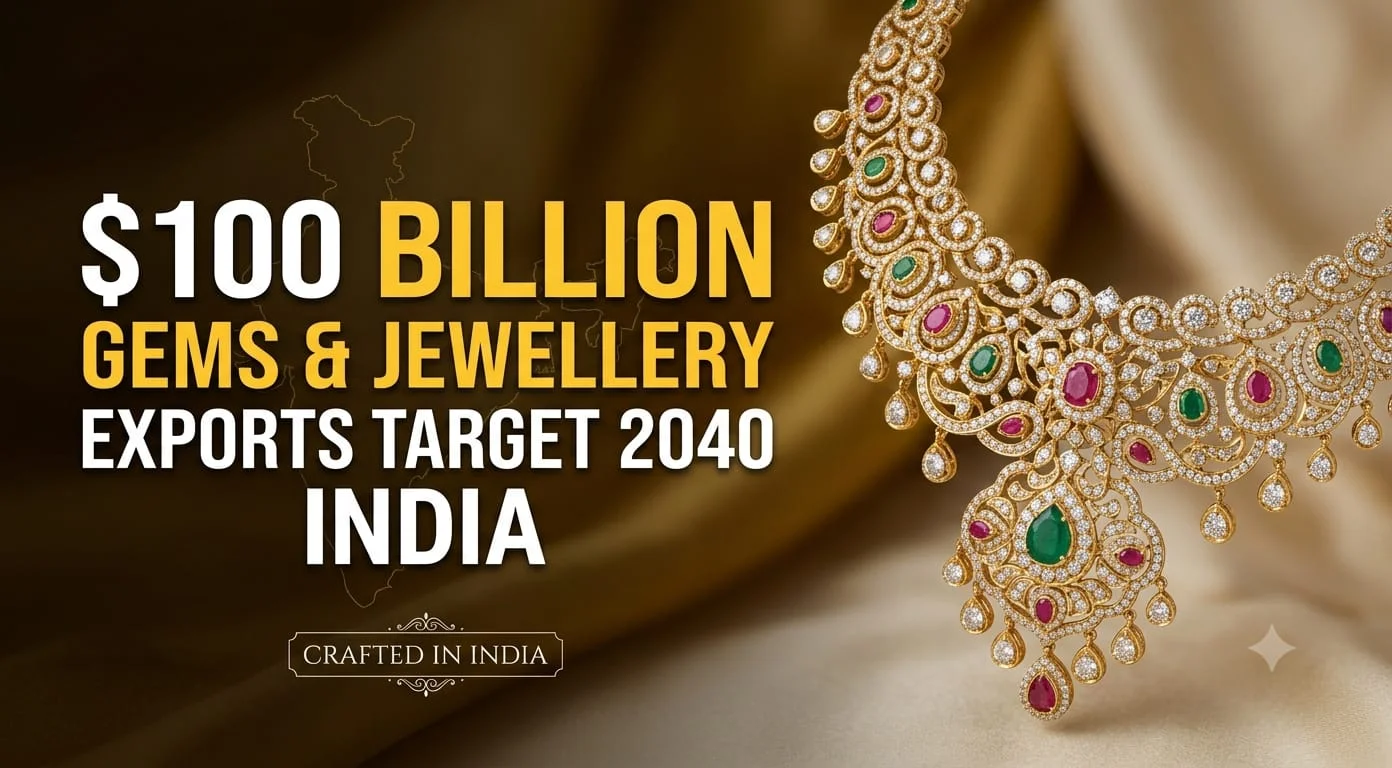
On August 20, the Department of Commerce, in association with the Gem & Jewellery Export Promotion Council, brought government and industry leaders together in Mumbai for the Chintan Shivir – 2040 Roadmap for Gems & Jewellery. The stated ambition is considerable: to take India’s gems and jewellery exports from USD 28 billion in 2025–26 to USD 100 billion by 2040. The sector is also projected to account for 1.2 per cent of India’s GDP and 14 per cent of the country’s merchandise exports by then.
A number like USD 100 billion naturally becomes the headline. But the more revealing part of the discussion was not the number itself. It was the recognition that India cannot reach it simply by making more jewellery.
Commerce Secretary Shri Rajesh Agrawal spoke of innovation, global design leadership and trust as the forces that could take the sector from its present scale towards the 2040 ambition. He also made a distinction that deserves attention: India’s strength does not lie in mining gold, silver or rough diamonds, but in the skilled people who transform those materials. Greater wealth creation, he argued, must come increasingly from design, innovation and global branding rather than basic manufacturing alone.
That is a significant change in language. For years, India’s jewellery story has been told through its manufacturing strength. The country can produce at scale, work with remarkable craftsmanship and serve some of the world’s largest jewellery markets. But there is a ceiling to being the place where someone else’s jewellery is made. The larger opportunity is to become the place where jewellery is imagined, designed, developed, branded and eventually desired.
In that sense, the $100 billion target is less about producing another billion dollars’ worth of jewellery and more about moving India further up the value chain.
The distinction sounds commercial, but it is also deeply cultural. A country can manufacture an extraordinary piece without the world knowing where the idea came from. It can possess generations of craft knowledge without the name of the craftsperson travelling with the finished jewel. It can create for an international brand and still remain invisible to the consumer who ultimately pays for it.
The roadmap appears to be asking India to become less invisible.
The phrase “Crafted by India”, one of the five missions emerging from the Chintan Shivir, is telling. Its stated objective is to build global recognition and value for Indian jewellery through design, intellectual property and branding. It suggests an ambition that goes beyond the familiar “Made in India” label. Manufacturing tells the world where something was produced. Craft, design and branding can tell the world why its origin matters.
That is where the country’s artisans become more than a workforce.
India’s skilled craftspeople are one of the few advantages that cannot simply be replicated by importing a machine or signing another trade agreement. Yet craft survives only when knowledge is passed on, and knowledge is passed on only when there is a future in it. The roadmap therefore places human capital alongside technology, calling for upgraded skills, more aspirational careers in craftsmanship and greater investment in the next generation.
There is something important in that pairing. India is not being asked to choose between the hand and the machine. It is being asked to make both more valuable.
Artificial Intelligence and 3D printing are already entering the industry’s vocabulary, and the roadmap specifically identifies them as tools for product differentiation. Technology can make production more precise, repeatable and efficient. But it cannot, on its own, decide which cultural reference deserves to become a modern jewel, how a proportion should feel on the body, or why one interpretation of a traditional technique feels alive while another feels dated.
That judgement remains human.
Perhaps India’s opportunity lies precisely there: in taking the capabilities of advanced manufacturing and placing them alongside a craft tradition that already knows how to make material feel meaningful.
The emphasis on design is therefore more consequential than it may initially appear. Design is often treated as the beautiful part of jewellery—the silhouette, the setting, the motif. In a global luxury economy, it is something much more valuable. It creates differentiation. It can become intellectual property. It gives a product a reason to exist beyond the weight of its gold or the size of its diamond.
The Chintan Shivir’s focus on finished, design-led and branded jewellery, along with intellectual property and global branding, recognises that shift. India does not necessarily need to compete with the world by making the same jewellery faster or cheaper. The greater opportunity may be to create jewellery that is harder to compare because the idea behind it belongs somewhere specific.
And that brings India’s history into the conversation.
The roadmap calls for India’s history, culture and stories to be integrated into jewellery design as a way of strengthening the country’s soft power. This is perhaps where the ambition becomes most interesting. India has never lacked stories, motifs or techniques. What it has sometimes lacked is the translation of those things into a contemporary language that can travel beyond the country without losing its character.
Heritage does not have to remain frozen to remain authentic. A traditional technique can sit inside a modern silhouette. A regional motif can be reduced to a line, a texture or a detail. A centuries-old idea can become something a customer in another part of the world wants to wear without needing to understand its entire history first.
The challenge is not to make Indian jewellery look more Indian.
It is to make Indian ideas desirable globally.
But none of this can happen through the largest companies alone. India’s jewellery ecosystem is too fragmented and too deeply rooted in smaller businesses for that. The roadmap identifies MSMEs as the backbone of the industry and places access to finance, technology and markets at the centre of their ability to scale.
This may ultimately be one of the most important parts of the entire ambition. A small manufacturer trying to move from contract production into design-led manufacturing needs capital. An artisan trying to build a workshop needs access to markets. A young designer needs technology and mentorship. An established family business looking towards exports needs simpler cross-border processes and a way to build recognition outside its existing network.
The $100 billion target therefore cannot simply belong to India’s largest exporters. If it is to change the character of the industry, it has to travel backwards through the ecosystem—to the workshop, the designer, the artisan, the MSME and the young person deciding whether jewellery is a career worth entering.
This is reflected in the five missions that emerged from the Chintan Shivir: expanding global market access, scaling MSMEs, simplifying export-import processes, building the value of “Crafted by India” through design and intellectual property, and developing the next generation of talent and design capability. Read together, they reveal something more interesting than a policy checklist. They describe an industry trying to change the way it participates in the global jewellery economy.
The ambition is ultimately about ownership.
Ownership of design. Ownership of intellectual property. Ownership of brands. Ownership of the relationship with the global customer.
The distinction becomes clearest in the roadmap’s closing aspiration: for India to evolve from an OEM manufacturing base into a global ODM and branding powerhouse.
OEM is about making what someone else has conceived. ODM takes the conversation further: design and development become part of the offering. Branding goes further still. It gives the product a name, an identity and a relationship with the person buying it.
That is where the economics of jewellery begin to change.
A country that earns from manufacturing captures one layer of value. A country that designs, owns the intellectual property, builds the brand and reaches the consumer captures several more. The same piece of jewellery can therefore mean something very different economically depending on how much of its story India owns before it leaves the country.
The roadmap also places this ambition within a much larger economic picture, projecting manufacturing output to reach approximately ₹15 lakh crore and the sector’s overall economic value to nearly ₹60 lakh crore. But the numbers, impressive as they are, are not what will ultimately determine whether the transformation has happened.
The real test will be visible in quieter places.
In whether an Indian designer can build a brand that a customer in Paris, New York or Singapore recognises without needing an international name attached to it. In whether an artisan’s technique becomes part of a contemporary global vocabulary rather than remaining confined to a workshop. In whether a small manufacturer can move from making for someone else to creating something of its own. In whether young talent sees jewellery not simply as a family trade, but as a field in which design, technology, business and culture can meet.
India already knows how to make jewellery for the world.
The harder task is to make the world remember that it came from India.
And perhaps that is what the 2040 roadmap is really asking of the industry.
Not simply to manufacture more. Not simply to export more. Not even simply to reach USD 100 billion.
But to take the things India has spent generations becoming good at—craft, making, design, stories, ingenuity—and turn them into something with a recognisable identity of its own.
Because the next chapter of India’s jewellery story may not be about proving that the country can make jewellery for the world.
The world already knows that.
The next chapter is about making the world recognise who designed it, who crafted it, where its story came from—and why that origin adds value.